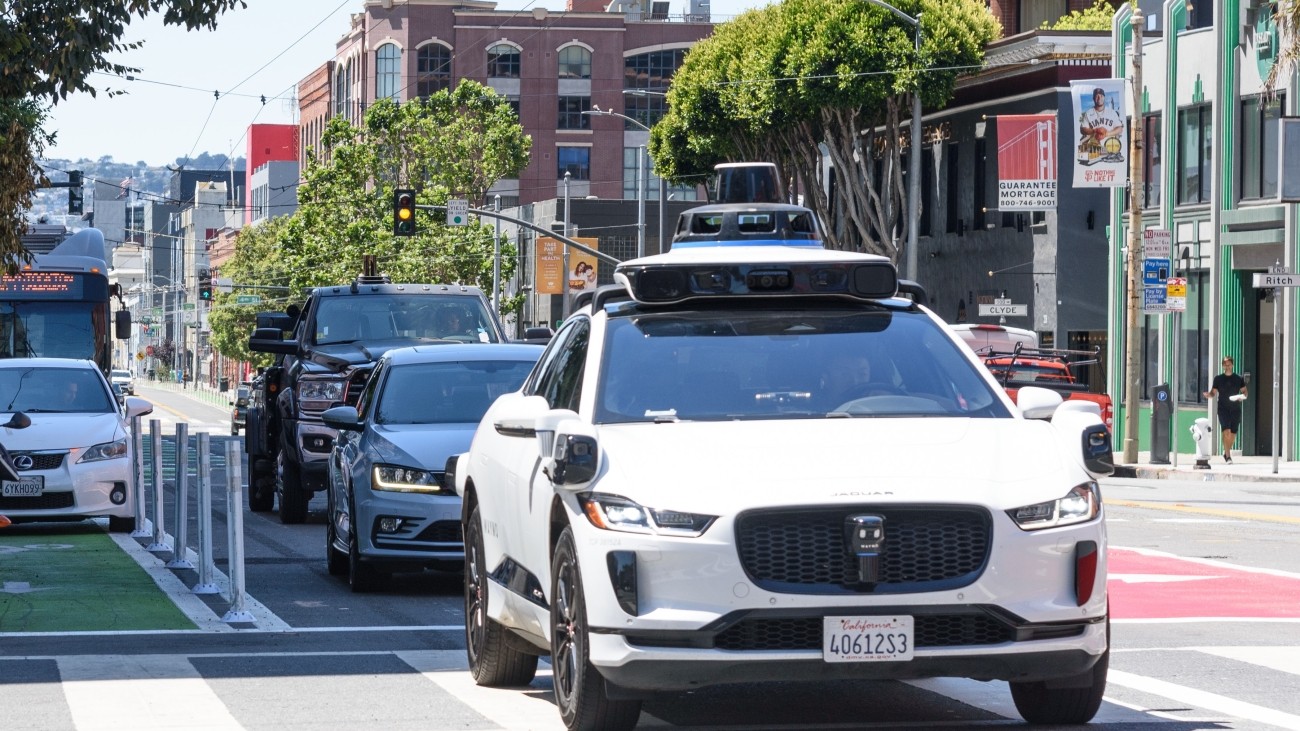
Photo by SFMTA Photography Department
On March 2, the Board of Supervisors Land Use and Transportation Committee held a hearing on Waymo’s Autonomous Vehicle fleet performance during the December 20, 2025 PG&E power blackout in San Francisco. The hearing was called by District 5 Supervisor and Transportation Authority Board Member Bilal Mahmood and co-sponsored by District 4 Supervisor and Transportation Authority Board Member Alan Wong. Its purpose was to examine Waymo’s operations during the blackout, the impacts on public circulation and safety, and how to prevent similar disruptions during resilience events in the future.
On December 20, 2025, a fire at a PG&E substation caused loss of power to roughly 30% of San Francisco, with over 1500 Waymo robotaxis stalled at darkened intersections or in traffic lanes, eventually leading the company to suspend service. In at least 63 instances, Waymo AVs had to be manually retrieved, with San Francisco first responders directly handling at least two vehicle removals. At least three Waymo vehicles directly hindered emergency services, delaying an ambulance for 40 minutes and blocking firefighters responding to two fires, one of which was the original PG&E fire.
Committee Chair Myrna Melgar presided over the hearing with Supervisors Chen, Mahmood, and Wong also participating. Representatives from the Department of Emergency Management, SF Fire Department, the Transportation Authority, and SFMTA presented information and answered questions from the supervisors.
Key topics that emerged during the hearing:
- Waymo acknowledged and apologized for December 20, 2025 disruptions. In response to supervisor and agency concerns, they cited a surge in remote assistance requests during the blackout that delayed response times and first responder hotline answers.
- San Francisco officials and Waymo agree that there is an overreliance on first responders removing disabled AV vehicles. SF officials expressed that it was not the city’s responsibility to remove vehicles, and that first responders should remain focused on emergency duties, a position Waymo representatives acknowledged.
- San Francisco officials stated that more timely and reliable communication and actions are imperative for Waymo to achieve going forward. SF officials expressed concern that Waymo’s response times with city emergency services, 311 staff and first responders were unacceptably slow and unreliable (taking almost one hour in one case), and that Waymo is expected to comply with emergency scene geofences and communications protocols, including those set out in legislation governing AV-first responder interactions at emergency sites (AB 1777, Ting).
- Waymo stated that the company has undertaken various initiatives, including adjustments to their automated driving system, increased training for emergency hotline dispatchers, and creating a triage-type of system for prioritizing operational issues. However, company representatives declined to disclose key details of interest to Supervisors when questioned, including how long disabled vehicles obstructed traffic, the ratio of remote operators to total operating fleet size, and when Waymo’s operational capacity would be increased to ensure better response times.
- Supervisors stressed the need for Waymo to develop stronger emergency and resilience event management capabilities and communication protocols given the resilience risks San Francisco faces. Supervisors asked Waymo and city agencies to partner with the Transportation Authority as we work with the Contra Costa Transportation Authority to utilize a federal Safe Streets for All grant to collaboratively develop coordination and communication protocols, tools and resilience action plans to be better prepared during major emergency events in the future.
To view a video recording of the hearing, visit the Transportation Authority’s AV Resources webpage here.